Wedding Venue Selection: How to Find a Place That Fits Your Guest List and Budget
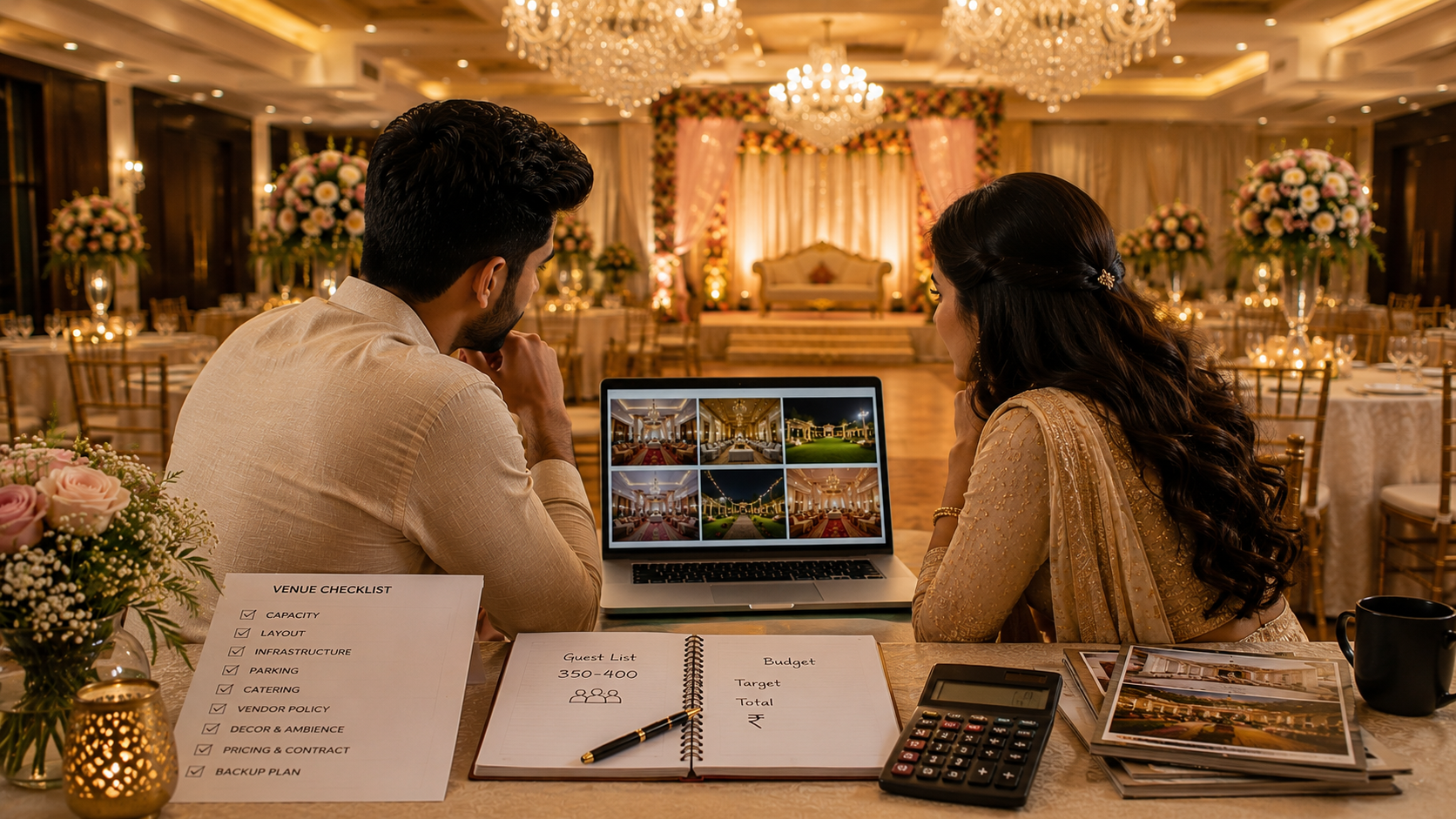
Most couples begin their wedding venue selection with two numbers in mind: a rough guest count and a rough budget. The search begins, and within the first few enquiries, a pattern emerges that nobody quite anticipated: the venues that comfortably hold the guest count cost more than the budget allows, and the venues within budget are either too small, too basic, or require minimum food and beverage spends that push the total cost past the original ceiling anyway. The guest list and the budget, which seemed like a reasonable combination when the planning started, don't line up in the venue market the way the initial planning assumed.
This tension is the single most common source of frustration in wedding venue planning, and it's largely predictable once you understand how venue pricing actually works. Venues don't just charge for the space. They charge for the space within a catering and minimum spend structure that sets a floor on the total per-head cost, which is often considerably higher than the venue hire fee alone suggests. A venue that appears affordable at the rental level becomes significantly more expensive once the per-head catering minimum is applied across a 400-person guest list.
This blog replaces the guesswork in wedding venue selection with a clear framework for aligning guest count, budget, and venue type before the search begins.
Why Guest List and Budget Rarely Align Automatically
The fundamental reason guest list and budget create tension in venue selection is that wedding venues price across multiple revenue streams simultaneously rather than through a single transparent hire fee. A banquet hall charges for the space, but its business model often depends on catering revenue that comes with minimum per-head spends. A hotel ballroom charges for the space, but the all-in package that makes the venue work as a wedding setting includes food, beverage, and service elements that aren't separable from the room hire.
When couples calculate their budget as "venue hire plus catering separately," they're applying a cost structure that doesn't match how most venues actually price. The real calculation is total per-head cost, which combines venue hire allocated across expected guest count with catering minimums and any additional service charges. For many venues, this all-in per-head figure ranges from ₹1,500 to ₹6,000 or more per person depending on the venue tier, location, and season, making guest count the dominant budget variable rather than an input to be confirmed after the venue is chosen.
The Two Mistakes That Create Most of the Tension
Most of the guest list-budget tension in wedding venue selection comes from two planning mistakes that compound each other rather than operating independently.
The Flexible Guest List Problem
Entering the venue search with a "roughly 300 to 400 people" guest count rather than a firmer number prevents accurate budget modelling because the difference between 300 and 400 guests at a per-head cost of ₹2,500 is ₹2.5 lakh, which is not a rounding error. It's a venue category. Venues quote based on confirmed guest counts, and without a firm number the comparison between venues is based on different assumptions that make the quotes incomparable.
Budgeting Only for Venue Hire
Allocating a specific amount "for the venue" without accounting for catering minimums and additional costs creates a false ceiling that the actual experience of booking consistently exceeds. The venue hire fee is the starting point of the cost, not the destination.
Choosing the Venue Before the Guest Count
Falling in love with a venue during a site visit before confirming whether it's the right size for the guest count creates emotional attachment that makes objective evaluation difficult. A venue that's slightly too small encourages compromises on guest list that have social and family consequences, while a venue that's too large for the guest count makes the event feel under-attended regardless of how beautifully it's decorated.
Comparing Venues Without Comparing Total Costs
Comparing venues on headline hire fees without converting each to a total per-head cost for the same guest count at the same function type produces misleading comparisons. A venue that quotes ₹3 lakh hire with ₹1,200 per head catering minimum is more expensive than one quoting ₹4 lakh hire with ₹800 per head minimum for 400 guests, but the headline fee comparison suggests the opposite.
How Much Should I Budget Per Head for a Wedding Venue in India?
Approximate all-in per-head ranges vary significantly by venue category, city, and season, but a practical framework for Indian markets outside of Mumbai and Delhi (which carry significant premiums) looks like this: community halls and smaller banquet halls run ₹800 to ₹1,500 per head all-in for basic catering packages. Mid-range banquet halls in established venues run ₹1,500 to ₹2,500 per head. Premium banquet halls and standalone wedding venues run ₹2,500 to ₹4,500 per head. Luxury hotel ballrooms and heritage properties run ₹4,500 and above, often considerably so during peak season. These are approximate ranges that shift with guest count, season, and specific menu selections, but they provide a realistic planning baseline rather than a venue-hire-only estimate that consistently underestimates the true cost.
Matching Venue Type to Guest Count and Budget
With a firm guest count and a total per-head budget established, matching venue type to both parameters becomes a structured exercise rather than an open-ended search. A practical reference framework by venue category:
Community halls and smaller banquet halls: comfortably seat 100 to 250 guests, total per-head cost ₹800 to ₹1,500, suitable for intimate or budget-conscious celebrations with outside catering typically permitted
Mid-range banquet halls: comfortably seat 250 to 450 guests, total per-head cost ₹1,500 to ₹2,500, typically with in-house catering at standard packages with some menu customisation
Premium banquet halls and dedicated wedding venues: comfortably seat 400 to 700 guests, total per-head cost ₹2,500 to ₹4,500, with higher catering quality and more venue service included
Luxury hotel ballrooms and heritage properties: comfortably seat 300 to 600+ guests depending on configuration, total per-head cost ₹4,500 and above, with full venue service, high catering standards, and typically strong accommodation adjacency
This framework lets couples identify which venue category their guest count and budget combination realistically falls into before beginning site visits, which focuses the search on options where the numbers can work rather than generating enthusiasm for venues where they can't.
How to Resolve the Gap When Guest List and Budget Don't Align
When the guest count and budget produce a per-head figure that doesn't fit any realistic venue category, four resolution options are available, each with genuine trade-offs.
The first is reducing the guest list. This is the resolution that most directly solves the problem but carries the most social and family complexity in the Indian context, where invitation decisions are often not entirely within the couple's control. Even a reduction of fifty guests at ₹2,000 per head is ₹1 lakh, which can move a family into a meaningfully better venue tier.
The second is accepting a lower venue category than originally envisioned. This is financially straightforward but requires recalibrating the aesthetic expectation of what the wedding space will look like, which some couples find easier than others depending on how central the venue's visual quality is to their wedding vision.
The third is restructuring the functions across smaller events: a larger main reception at a mid-tier venue supplemented by a smaller, more intimate ceremony or pre-wedding gathering in a premium space, rather than expecting one venue to serve both functions at the same quality level.
The fourth is adjusting the catering package rather than the venue tier: choosing a more basic menu within the same venue to bring the per-head cost to a workable level rather than moving to a lower venue category. This requires the venue's package structure to offer meaningful menu flexibility, which premium venues sometimes resist.
Venue By Choice helps couples work through exactly this matching process, surfacing venues where the guest count, budget, and format combination are genuinely viable rather than requiring a discovery process through venues where the numbers don't align. Their listings across venue types and budget tiers are available at venuebychoice.com.
How Do I Know If a Venue Is the Right Size for My Guest List?
The comfortable seated capacity for your specific event layout is the right benchmark rather than the venue's quoted maximum, and a few practical checks confirm the fit:
Ask for the room layout at your specific guest count with all the elements your wedding requires: seating, stage or mandap, dance floor, catering stations, bar if applicable, and service circulation space
Confirm that the resulting layout feels naturally full rather than either cramped or sparse, since both extremes affect the guest experience and the atmosphere of the event
Check the ceiling height relative to any stage or décor elements that require vertical clearance, since low ceilings constrain what's achievable even in a room with adequate floor area
Verify parking capacity against your expected vehicle count rather than accepting a general assurance that parking is available, since parking constraints affect guest experience from arrival
If the venue is hosting multiple events simultaneously, confirm that the sound and space separation between events is genuine rather than dependent on cooperative timing from another booking
Conclusion
Effective wedding venue selection begins with converting the guest count and budget into a realistic per-head figure before the venue search starts, then using that figure to identify which venue category the combination realistically falls into. This front-loaded planning step replaces the frustration of discovering mid-search that the guest list and budget don't align with a structured approach that focuses the search on options where the numbers actually work.
The couples who navigate this process most smoothly are almost always the ones who treated the guest count as a firm input and the total per-head cost as the relevant budget metric from the beginning, rather than discovering both through the inefficiency of visiting venues that were never going to work. Getting these two numbers right before the first site visit is the single most effective investment available in the early stages of wedding planning.