
Veg Wedding Catering: What Dishes Should Your Menu Include?
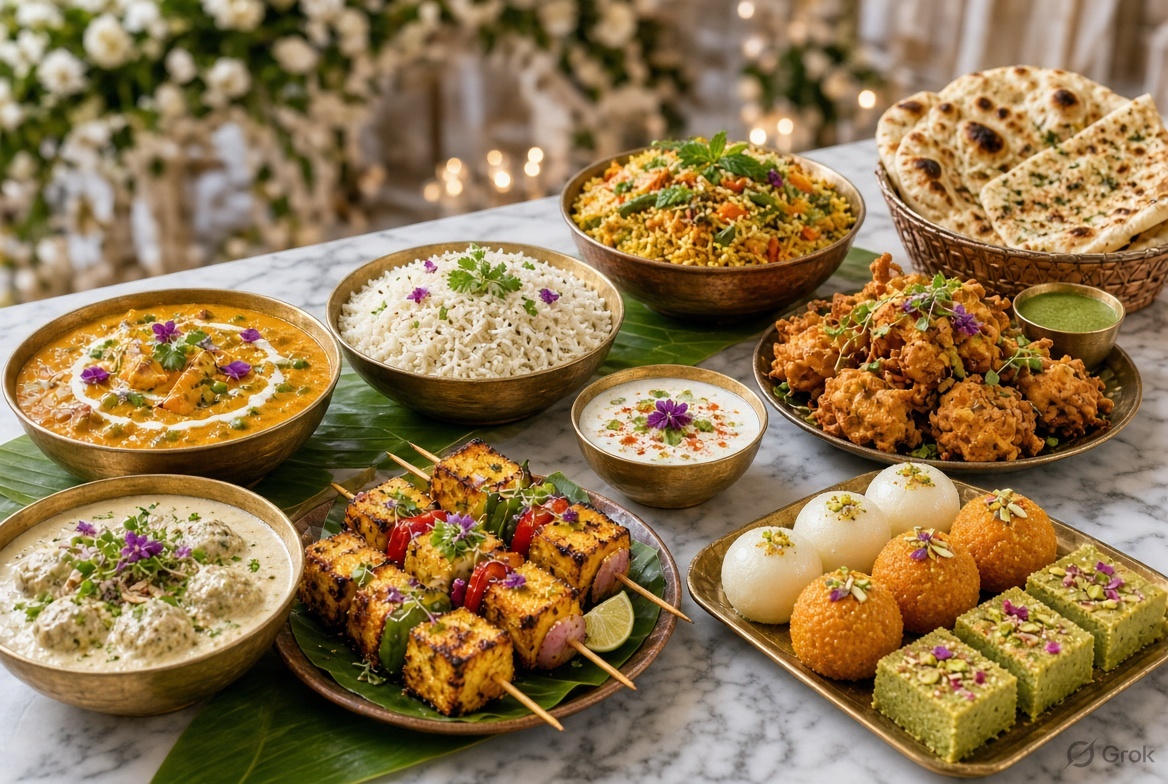
Good veg wedding catering has less to do with how many dishes you serve and more to do with how the meal is sequenced. A well-built menu moves guests through welcome drinks, starters, a main course and desserts at a pace that leaves them satisfied rather than stranded halfway through a buffet line with a full plate and no appetite.
That principle matters more in Patna and Kolkata than most families expect, because both cities have vegetarian traditions far richer than the standard paneer-and-naan spread that caterers default to. A Bihari wedding table and a Bengali niramish spread are genuinely different meals, and building around them costs no more than building around generic North Indian food.
In this blog, we'll walk through how to structure the menu, how many dishes it really needs, which regional dishes deserve a place, and what it should cost.
How a Veg Wedding Menu Should Be Structured
Think of the meal as a sequence rather than a list. Most well-run vegetarian weddings follow roughly this order:
Welcome drinks: two or three options, including one non-sweet choice like jal jeera or nimbu pani
Starters: four to six, mixing fried, tandoori and chaat-style items
Live counters: one or two, placed away from the main buffet to spread crowds
Main course: three to five vegetable and paneer preparations, one or two dals
Breads and rice: luchi, puri or roti alongside a pulao or biryani
Accompaniments: chutney, papad, salad, raita
Desserts: three to five, with at least one served hot
The sequence does the work. Guests who get a proper starter course eat less erratically at the buffet, which reduces both queue pressure and wastage.
How Many Dishes Does a Vegetarian Wedding Menu Actually Need?
Between 15 and 25 dishes across all courses is enough for almost any wedding, including large ones. Beyond that, you are paying for items most guests will never touch.
Families often read a longer menu as a sign of generosity, but guests sample selectively rather than working through everything on offer. Cutting four redundant dishes and spending that budget on better ingredients or an extra service counter almost always produces a better meal. Two excellent paneer preparations beat six average ones.
Regional Dishes Worth Building the Menu Around
This is where most veg wedding menu ideas fall flat, defaulting to the same national shortlist. Both these cities offer better.
Patna: The Bihari and Marwari Table
Litti chokha works beautifully as a live counter, served hot with ghee and aloo-baingan chokha. Add sattu paratha, ghugni, kadhi badi and dal pitha for genuine local character. Many Patna families also draw on Marwari cooking, where dal baati churma, gatte ki sabzi and ker sangri add variety that standard North Indian caterers rarely offer. For sweets, khaja, malpua, thekua and makhana kheer carry more meaning than imported options.
Kolkata: The Bengali Niramish Spread
Bengali vegetarian cooking has real depth and follows a traditional bitter-to-sweet progression. Open with shukto, then build the main course around cholar dal with narikel, aloo posto, dhokar dalna, chhanar dalna, mochar ghonto and potoler dorma. Enchorer dalna, the jackfruit curry often called vegetarian mutton, is a strong centrepiece. Serve with luchi and basanti pulao, and close with mishti doi, rosogolla, sandesh and payesh.
Shared Staples That Travel Well
Keep a small familiar section for guests from outside the region: a paneer gravy, a dal makhani, a biryani or pulao, and one Indo-Chinese starter. Keep it small, though. If half the menu is generic, the regional identity disappears.
What Should Veg Wedding Catering Cost Per Plate?
In Patna, dedicated pure-vegetarian caterers typically quote around ₹650 to ₹750 per plate for a full spread, while hotel banquets with in-house kitchens start closer to ₹1,800. In Kolkata, a simple Bengali vegetarian menu runs roughly ₹250 to ₹400, a standard one ₹450 to ₹700, and premium menus with live counters and a dessert station from ₹800 upward.
The per-plate figure is rarely the whole story. Ask specifically whether GST, crockery upgrades, extra counters, additional service staff and transport are included, then compare final package totals rather than headline rates.
Practical Choices That Protect the Guest Experience
Check the venue's catering policy before you fall in love with a caterer. Many banquet halls and hotels require in-house catering or charge a royalty for outside vendors, and some lawns lack the kitchen infrastructure for elaborate live counters.
Build seasonally. Mochar ghonto, potoler dorma and lal shak are seasonal by nature, and a caterer who insists otherwise is probably not cooking them well. Finally, confirm a sattvic or no-onion-garlic section if your families observe it, prepared separately rather than adapted at the last minute.
Conclusion
Strong veg wedding catering comes down to three decisions: structure the meal as a sequence, keep the dish count disciplined, and let the region do the heavy lifting on flavour. Patna and Kolkata both give you a vegetarian repertoire worth showing off, and using it costs no more than defaulting to a generic spread.
The menus guests remember are rarely the longest ones. They are the ones where every dish was worth eating, the hot items arrived hot, and the food tasted like it belonged to the place the wedding was held in.