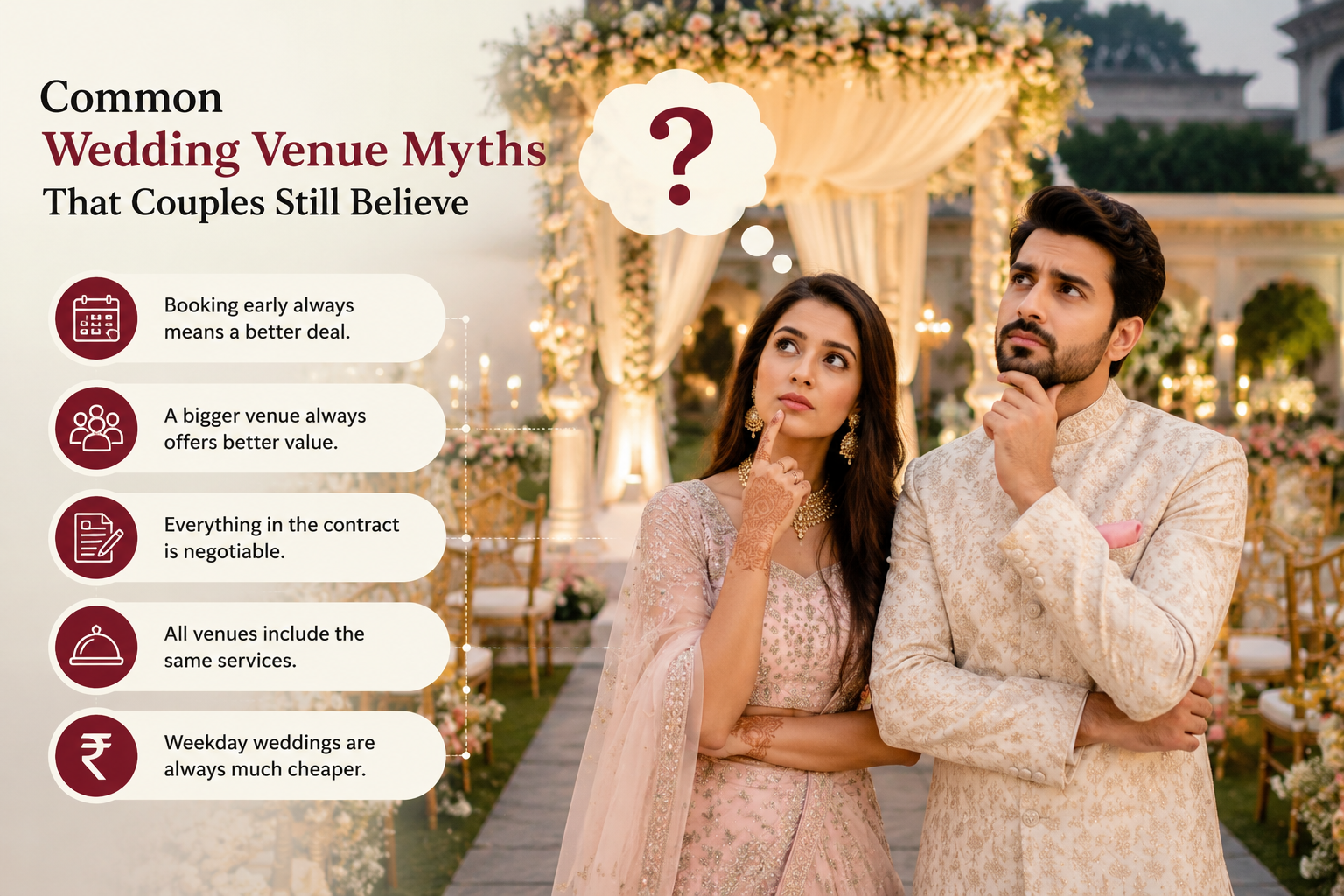
Common Wedding Venue Myths That Couples Still Believe
Wedding venue myths are uniquely persistent because they travel through the most trusted channels available: parents who planned their own children's weddings years ago, friends who booked a venue recently and are sharing what worked for them, and general wedding venue planning advice that blends genuine insight with outdated assumptions. By the time most couples start their venue search, they're already carrying a set of beliefs about how venue booking works that shapes every decision they make, often in ways that cost them money, time, or both.
The problem isn't the advice-givers. It's that venue markets, pricing structures, and what venues include in their packages have changed considerably, and the received wisdom hasn't kept pace. Acting on a myth in wedding venue planning doesn't just produce a suboptimal outcome. It can mean losing a preferred date, signing a contract with unexpected terms, or arriving at the wedding day to discover that something assumed to be included isn't.
In this blog, we will work through five of the most common wedding venue myths and replace each one with a more accurate picture of how venue booking actually works.
Myth 1: Booking Further in Advance Always Gets You a Better Deal
The belief that earlier booking equals better pricing is deeply embedded in wedding planning culture, and it's partially right for exactly one thing: availability. Booking twelve or eighteen months ahead of a popular date does meaningfully increase the chance of securing that date at a preferred venue. It does not, in most cases, produce lower pricing than booking six months out for the same date.
Venue pricing on in-demand dates is driven by demand, not by how far in advance the booking is made. A premium venue on a peak wedding date in November or December will charge peak-season pricing whether you enquire in January or in August of the same year. The myth conflates two different things: the advantage of early booking for date security and the pricing leverage that comes from being an early enquirer. The first is real. The second rarely materialises in the way couples expect.
What advance booking genuinely protects, and what it doesn't:
It protects the specific date at the specific venue against other couples booking it first
It gives more time for vendor coordination around the confirmed date
It does not typically produce a lower per-head or venue rental cost
It does not guarantee flexibility on package inclusions that the venue treats as fixed
It may actually reduce leverage on certain negotiation points since the venue knows demand is strong well in advance
Myth 2: A Larger Venue Means Better Value for a Bigger Guest List
Bigger guest list, bigger venue, lower per-head cost. The logic feels sound and doesn't hold up well in practice. Per-head venue costs don't improve linearly with scale, and the atmosphere considerations that large venues introduce create real problems that efficient pricing can't compensate for.
An oversized venue makes a gathering feel sparse regardless of actual numbers, and Indian wedding photography and videography both suffer in rooms that look significantly emptier than expected. Conversely, an undersized venue creates a different but equally real problem: crowded, uncomfortable guests and limited space for the functions that a full wedding celebration requires. The right venue size is the one that makes your specific guest count feel full and comfortable without either extreme, and that number isn't determined by a pricing calculation.
Should I Always Book a Wedding Venue as Early as Possible?
For peak-season dates, particularly in October through December in most Indian cities, early booking is genuinely important for availability rather than for pricing. For off-peak dates, the urgency is considerably lower, and booking earlier than necessary can actually reduce leverage in contract discussions since the venue has less immediate incentive to offer flexibility when demand isn't time-pressured.
The practical rule is to begin venue conversations early enough to make a considered, unrushed decision rather than a pressured one. For popular dates, that may mean twelve months ahead. For more flexible timing, six to eight months is often sufficient without creating artificial urgency that works against the couple's negotiating position.
Myth 3: Everything in a Venue Contract Is Negotiable
This is the myth that produces the most friction between couples and venue managers, because walking into contract discussions expecting everything to be moveable sets up disappointment when fixed elements turn out to be genuinely fixed.
What Is Usually Negotiable
Catering package specifics, menu choices, beverage arrangements, and sometimes the inclusion or substitution of specific services that the venue offers are typically the most responsive to discussion. Timing flexibility for setup and breakdown, vendor access policies, and the allocation of spaces within the venue across multiple functions are also often discussable.
What Is Rarely Negotiable
Base venue rental pricing on peak-demand dates, minimum guaranteed spend requirements, and terms relating to liability and damage deposits are almost universally fixed. These aren't arbitrary positions: they reflect the venue's genuine financial and operational requirements rather than a starting position in a negotiation.
When Negotiation Works Best
Negotiation produces the best results when the date is off-peak, when multiple functions are being consolidated at one venue, or when a couple is genuinely flexible on specific elements rather than using negotiation language while firmly committed to a particular outcome.
How to Approach Venue Negotiations Without Damaging the Relationship
The couple and venue team will be in contact repeatedly between booking and the wedding day, and a relationship strained by aggressive early negotiation tends to produce less cooperative responses to requests later. Raising questions clearly, asking what flexibility exists rather than demanding concessions, and treating fixed terms as information rather than positions to overcome keeps the relationship functional throughout the planning period.
Myth 4: The Venue Handles Everything So You Don't Need to Verify
This is the assumption that causes the most wedding-day surprises, and it usually comes from a phrase like "we take care of everything" that appears in a sales conversation but has no specific definition in the contract that follows.
What "everything" means varies enormously between venues and packages. At some properties it genuinely includes catering, decor coordination, accommodation, and on-day event management. At others, it means a room, basic furniture, and a kitchen for an outside caterer. Both versions can be described with the same marketing language, and the gap between them only becomes clear when the contract is read carefully or, worse, when the wedding day arrives.
Verifying every inclusion, and getting those inclusions specified in writing rather than in conversation, isn't distrustfulness. It's the basic due diligence that prevents the most common and most painful category of wedding planning disappointment. Venue By Choice helps couples cross-check exactly what's included in each venue package before any commitment is made, making the comparison between venues based on actual value rather than assumed content. Their listings are available at venuebychoice.com.
Myth 5: A Popular Venue Is Automatically the Right Choice
Popularity is a proxy metric that measures demand, not fit. A venue can be consistently in demand for completely legitimate reasons, strong infrastructure, reliable catering, experienced staff, while being an entirely wrong choice for a specific couple's wedding in terms of size, aesthetic, guest logistics, or the particular functions they're planning.
The most photographed venue in a city is optimised for the couples whose weddings look good in large, formal settings. A smaller, more intimate gathering may be overwhelmed by the same space, with guests spread too thin across a room designed for twice the number. The right question when evaluating a popular venue isn't "is this venue well-regarded?" but "is this venue well-suited to our specific wedding?"
Can You Negotiate Wedding Venue Prices?
On some elements, yes, particularly in specific circumstances:
Off-peak dates carry meaningfully more price flexibility than peak-season bookings, since the venue has a stronger incentive to fill its calendar during quieter periods
Multi-function bookings, where mehendi, sangeet, and reception are all at the same venue, often unlock bundled pricing that isn't available for single-function enquiries
Catering menu customisation and beverage package adjustments are frequently more negotiable than the base venue hire fee itself
Setup and breakdown time extensions may be negotiable where the venue's calendar allows, since these cost the venue relatively little to grant
Service add-ons like floral arrangements, audio-visual equipment, and photography coordination are often more flexible than the core package price
What rarely moves, regardless of how the request is framed, is peak-date base pricing at venues with strong demand. Knowing this before entering negotiations allows couples to focus their energy where flexibility actually exists rather than on fixed elements that will remain unchanged.
Conclusion
Wedding venue myths persist because they feel like sensible rules of thumb, and sometimes they contain a kernel of truth that gets generalised beyond its actual application. Understanding the reality behind each one, what advance booking actually protects, how negotiation genuinely works, and why popularity doesn't equal fit, gives couples a significantly clearer picture for making decisions that are genuinely right for their wedding rather than ones that match inherited advice.
The couples who navigate venue booking most effectively are almost always the ones who asked specific questions rather than relying on assumptions, and who treated venue manager conversations as information-gathering rather than confirmation of what they already believed. That approach doesn't require cynicism about venues. It just requires the willingness to verify rather than assume, which is the single most protective habit available throughout the wedding planning process, and you can Contact Us.