Wedding Reception Venues: How to Match Your Guest List, Décor and Celebration Style
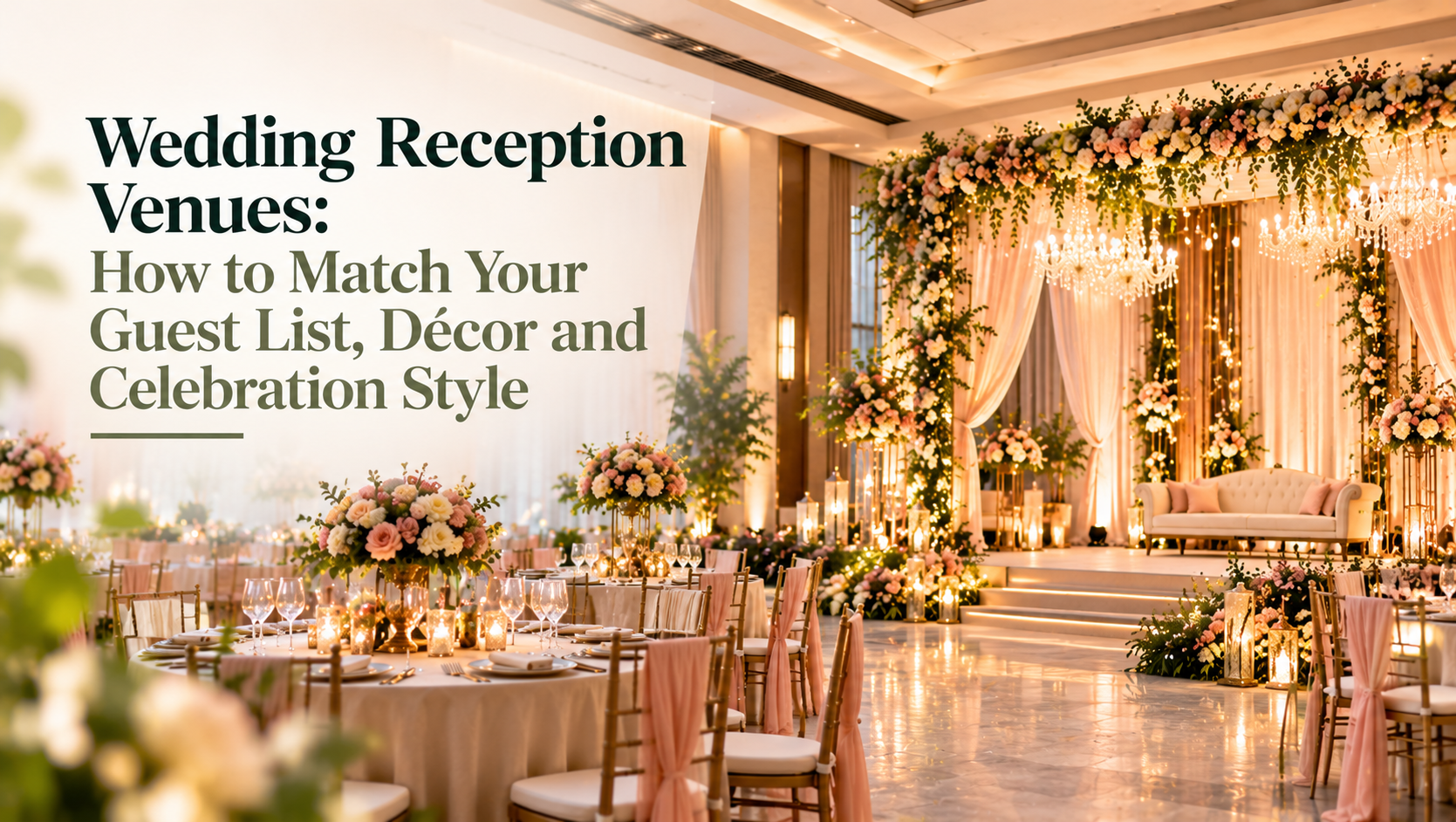
Choosing wedding reception venues that truly work comes down to one central question: do your guest count, your décor vision, and your celebration style all point toward the same kind of space? When they do, everything else in the planning process becomes cleaner. When they don't, couples find themselves decorating around structural limitations, managing an overcrowded room, or standing in a vast hall that feels half-empty by nine in the evening.
The challenge is that most couples approach the search one factor at a time. They find a venue they love the look of, fall for the ambience during a site visit, and then begin the process of making the guest list and décor fit around it. That sequence tends to produce compromises that are entirely avoidable. The three variables work together, and treating them separately is usually where the mismatch begins.
In this blog, we'll walk through how to align your guest count, celebration style, and décor vision so that the venue you choose actually serves all three.
Why the Guest Count Should Drive the Venue Decision First
Of the three factors, guest count is the most concrete and the least flexible. It is also the one that most directly determines which venues can even be considered. A space that comfortably seats 150 is not the right venue for 300 guests, however beautiful it is. A hall built for 500 will feel cold and oddly quiet for an intimate gathering of 80.
Getting capacity right is not simply about fitting everyone in. A well-sized venue allows for a dining area, a dance floor, a stage or performance area, a refreshment counter, and clear movement between all of them. If any of those elements start to feel cramped or are eliminated entirely to accommodate numbers, the guest experience suffers in ways that even excellent catering and décor cannot fully compensate for.
When you start the venue search with a firm guest count range rather than a dream aesthetic, you immediately rule out spaces that will not work and focus attention on those that will. Everything else, including décor, becomes a conversation you can have within a venue that already fits.
How Does Your Celebration Style Shape the Venue You Need?
The style of your reception determines the spatial requirements as much as the guest count does. A formal sit-down dinner for 200 guests needs a very different floor plan than a festive cocktail-style gathering for the same number. And an intimate seated reception for 60 close family members has almost nothing in common, architecturally, with a large multi-function celebration that runs across an evening.
Consider three common formats. A traditional sit-down reception typically requires a clearly defined dining layout, a dedicated stage for the couple and family, and enough flow between tables for guests to move comfortably. A cocktail-style celebration, increasingly popular among urban couples, relies on a mix of high tables, lounge seating, and open space that encourages movement and mingling rather than a fixed seating arrangement. An intimate celebration prioritises warmth and closeness over grandeur, and often benefits from a smaller, more characterful space rather than a large formal hall.
Knowing which of these formats fits your vision before you visit venues changes what you are actually evaluating during a site visit.
Wedding Reception Venues and the Décor Question
The relationship between wedding reception venues and décor is less about how much you spend and more about how well the space and the styling work together. A venue with a strong existing architectural character, ornate interiors, or a distinctive colour palette will either complement your décor vision or compete with it. Neutral spaces offer more freedom; characterful ones require more careful planning.
For reception hall decoration to land well, the venue needs to support it structurally. High ceilings allow for dramatic floral installations and hanging lights that simply are not possible in a low-ceilinged hall. Large windows and natural light change how colours and fabrics read during a daytime reception. Existing flooring, wall treatments, and built-in lighting fixtures all factor into how much your external décor needs to do to create the look you want.
A useful exercise during any venue visit is to mentally strip the space of all existing furniture and ask what you are actually working with. The bones of the room, its proportions, height, and light, are what your décor will ultimately have to work with or around.
Can You Decorate a Venue to Suit a Style It Was Not Designed For?
Yes, within limits. Some elements of a venue are genuinely fixed: the height of the ceiling, the placement of columns, the dimensions of the room, and the colour of permanent flooring. These are not changed by draping fabric or adding floral. What is highly changeable is the atmosphere. Lighting is the single most powerful tool available for transforming a space, and it is available at almost every budget level. The shift from standard overhead lighting to warm, layered, and directional light sources changes the feel of a room more dramatically than almost any other décor element.
Linens, centrepieces, floral arrangements, and stage backdrops are all highly impactful and fully flexible. Investing décor budget in these areas, particularly lighting and the focal points guests see most often, tends to deliver a stronger overall effect than spreading the same amount thinly across every element of the room.
Bringing It All Together Before You Book
The most confident venue decisions come from evaluating all three criteria together rather than in sequence. When you visit wedding venues for receptions, ask whether the space can hold your guest count comfortably in the layout your celebration style requires, and whether the room's existing character supports or challenges your décor direction. Those three questions, answered honestly during a site visit, will tell you more than any photograph.
It also helps to ask the venue whether you can see the space set up for an event similar to yours in size and format. Seeing the room configured for a 150-person sit-down reception is significantly more useful than seeing it empty or arranged for a corporate event.
Conclusion
Matching your guest list, celebration style, and décor vision to the right wedding reception venues is a process of alignment, not compromise. When all three are considered together from the start, the space you choose becomes a foundation that every other decision builds on naturally, rather than something you are constantly adjusting around.
The most memorable receptions are rarely the most elaborately decorated ones. They are the ones where the venue and the vision were in conversation with each other from the beginning, and where the guests spent the evening enjoying the celebration rather than noticing what did not quite fit.