
Wedding Catering Packages: How to Plan Food for Every Guest
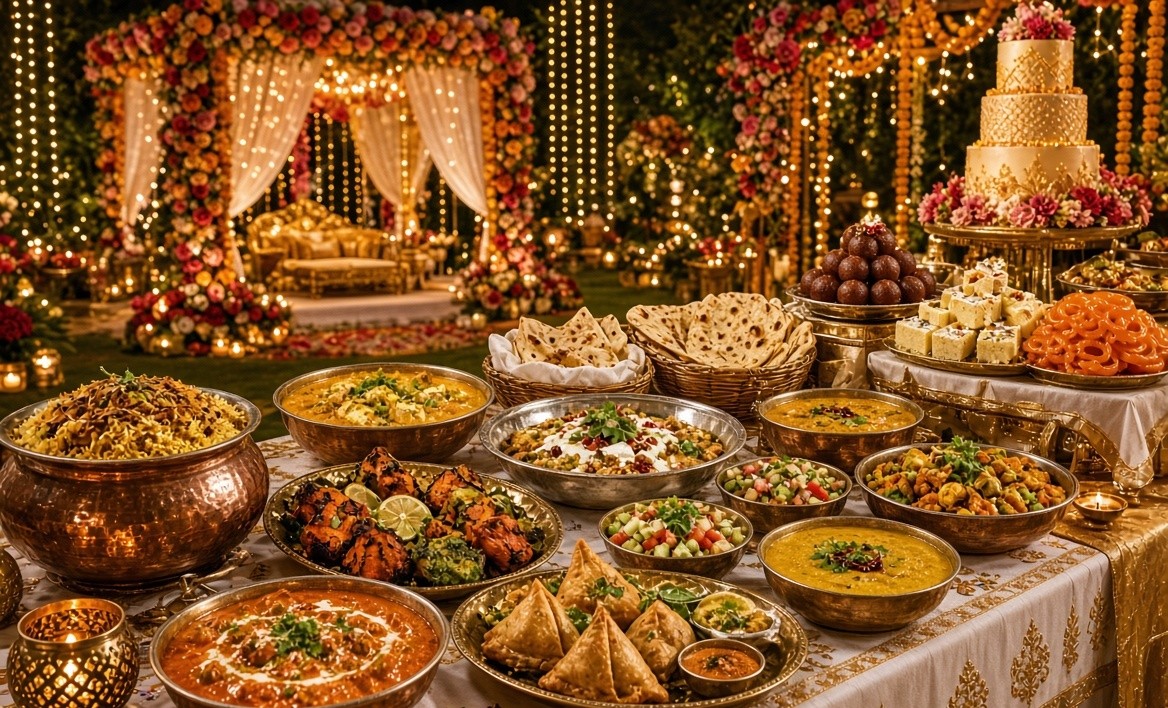
packages in India are almost always quoted per plate rather than as a single lump sum, which sounds straightforward until you notice the number on the flyer is rarely the number on the final bill. Food usually accounts for somewhere between 40 and 55 percent of combined food and venue spend, so a ₹500 swing in the per-plate rate across 500 guests is ₹2.5 lakh.
The other complication is that an Indian wedding is never one meal for one kind of guest. It is four or five functions across two or three days, served to a list that includes vegetarians, Jain relatives, small children, elderly grandparents and out-of-town friends eating this food for the first time.
In this blog, we'll break down how catering is priced, what a package should include, how to plan for a genuinely mixed guest list, and why your venue quietly decides most of it.
How Catering Packages Are Actually Priced
You agree a Catering rate for one guest's complete meal, then multiply it by the number of covers. Three practical tiers cover most weddings: roughly ₹600 to ₹1,200 per plate for buffet service with eight to twelve dishes and no live counters, ₹1,200 to ₹2,000 for the mid tier, and ₹3,000 to ₹8,000 and above at five-star properties.
The veg versus non-veg assumption trips up most families. The gap is usually ₹200 to ₹800 per plate rather than a doubling, because chicken and paneer sit close in cost and the fixed costs of staff, setup, breads, rice and desserts are identical either way. Many premium venues price the two within ₹300 to ₹500 of each other. The genuine premium comes from mutton, prawn and specialty seafood, which can add ₹500 to ₹1,500 depending on grade and quantity.
Live counters are the other lever. Each premium station adds roughly ₹500 to ₹1,500 per plate, which is why a quote can climb sharply between the first conversation and the final menu.
What Should Wedding Food Packages Include?
A per-plate rate typically covers the food itself, basic service staff, crockery and buffet setup. What sits outside it is where budgets slip.
GST, charged separately on the food invoice
Plated service staff, often ₹500 to ₹2,000 per person per event, with mid-range receptions needing twelve to sixteen
Live counters and premium desserts, priced as add-ons
The minimum guarantee, meaning the head count you pay for regardless of attendance
Ask for the dish count per course, the staff-to-guest ratio, the counter list and the tax treatment in writing before you sign anything. Verbal assurances at a tasting have a way of evaporating by the event date.
Planning Food for Every Guest on Your List
Coverage matters more than abundance. A guest who finds nothing they can eat remembers that far longer than a guest who counted only six starters instead of eight.
Dietary Requirements
Strict Jain preparation, excluding root vegetables, onion and garlic and cooked in a separately staffed kitchen, typically adds ₹300 to ₹600 per plate. Apply that surcharge to the Jain head count alone rather than the full list. The same principle covers halal requirements and allergen labelling: confirm with your wedding catering services team that separation is maintained through serving, not just cooking.
Elders and Children
Older guests generally want familiar, traditional dishes at the pheras and the reception, served at a gentler spice level. Keep something plain and comforting available at every function, since it reliably outperforms the elaborate options. Children need simple, mild food they can eat without assistance.
Function-by-Function Formats
Each event needs a different service format, not just a different menu. Mehendi guests arrive in waves and eat standing with one hand occupied, so finger food works. Sangeet guests eat in short windows between performances and need fast, shareable service. The reception is where a full seated plate is expected.
How Do You Reduce Per-Plate Cost Without Cutting Quality?
Cut counters before you cut the menu. Removing two premium stations saves more than removing four dishes, and guests notice it far less.
Then trim the number of dishes rather than their quality. One well-executed hero non-veg dish satisfies a table more than three average ones, and the same logic applies across the whole spread. Finally, negotiate your guarantee count honestly, because you pay for plates promised rather than plates eaten. Inflating the number to look generous is simply a donation to the caterer.
Why Your Venue Decides Your Catering Options
Most five-star hotels mandate in-house catering as a condition of booking the banquet, which settles your catering decision the moment you sign. Standalone halls usually allow outside caterers but charge a royalty or kitchen-usage fee of roughly ₹300 to ₹1,000 per plate, so calculate the all-in figure before assuming outside is cheaper.
Tax treatment also follows the contract structure rather than the food. Composite packages where hall and catering are billed together can attract 5 percent GST, while standalone catering typically attracts 18 percent. Ask the venue to state this in writing.
Conclusion
Catering packages reward the families who read the fine print rather than the ones who compare headline rates. The per-plate number is a starting point that gets moved by counters, proteins, staffing, the guarantee clause and the tax structure, and none of those announce themselves in a brochure.
Start from your venue, since it determines your catering freedom, your minimum spend and often your caterer. Get the policy in writing before the advance leaves your account, and the rest of the food planning becomes a much smaller problem.