
Rooftop Reception Venues: What to Consider Before Booking One
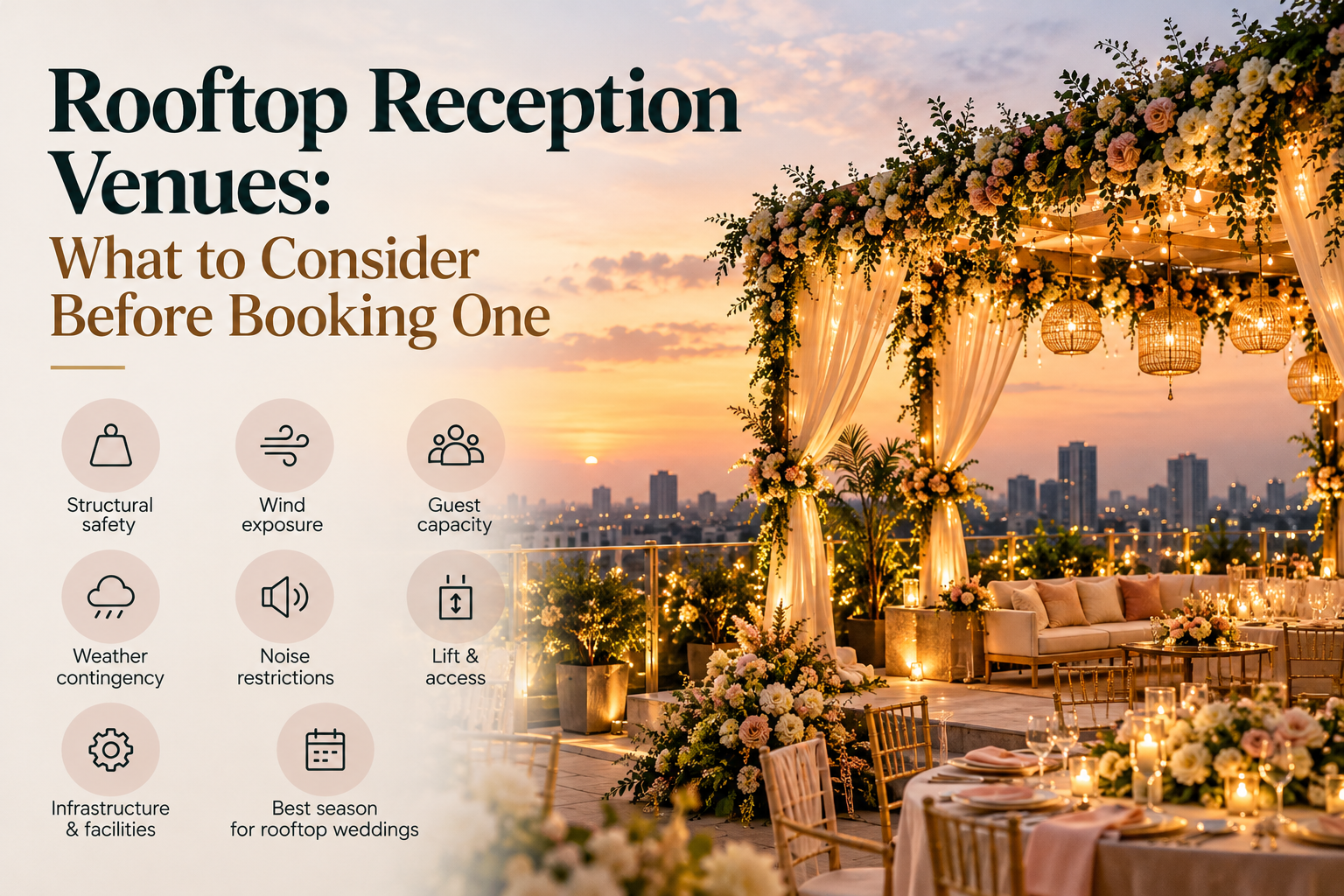
Rooftop reception venues offer something that very few other venue types can: an elevated setting with city views, open sky above a celebration, and the particular contemporary aesthetic that an urban rooftop produces. The appeal is immediate and genuinely distinctive, which is why rooftop receptions have become one of the more sought-after venue formats for couples whose vision includes a backdrop that no ballroom can replicate. What the appeal doesn't reveal is that rooftop venues carry a set of structural, operational, and logistical considerations that are unlike anything a standard venue evaluation covers, and that the site visit impression, typically conducted in calm conditions, with an empty space and cooperative weather, tells you less about the rooftop reception experience than it tells you about almost any other venue type.
A rooftop venue booking made on the strength of a site visit alone and without the specific checks described in this blog is one of the higher-risk venue commitments available in the Indian wedding market. The considerations aren't reasons to rule rooftop venues out: they're reasons to verify specifically that the venue you're considering handles each one before the booking deposit is paid.
This blog walks through the specific things to check before booking a rooftop venue for a reception, so the decision is made with the full picture rather than the site visit impression alone.
Verify the Structural Load Capacity Before Anything Else
Every rooftop has a structural load capacity: the maximum weight per square metre that the roof's load-bearing structure can safely support. For a residential or commercial building whose roof has been adapted for event use, this capacity may be significantly lower than the loads that a reception with a full guest list, catering equipment, temporary stage and speaker structures, and furniture will collectively generate.
Ask the venue specifically what their certified load capacity is and whether it has been assessed by a structural engineer rather than estimated by the venue management. A rooftop that can safely hold 150 people in standing configuration may not safely hold the same 150 people plus the full catering equipment, bar setup, furniture, and temporary stage that a seated reception involves. The distribution of load matters as much as the total: a catering tent structure concentrated in one area adds significantly more localised load than the same weight distributed across the guest area.
This conversation is one that venues whose rooftops are genuinely designed for events will have ready answers to. Venues where the question produces uncertainty or deflection are venues where the structural assessment may not have been done with the rigour a large reception requires.
Assess Wind Exposure Honestly
Wind is the rooftop venue characteristic most consistently underestimated during site visits because rooftop wind conditions vary dramatically with weather, time of day, and season. A site visit on a calm afternoon gives essentially no information about how the rooftop performs during the kind of evening conditions that a December or February reception will actually experience.
Decoration and Installation Limitations
Elevated wind exposure creates specific limitations for rooftop decoration that ground-level venues don't face. Floral arch structures, hanging ceiling installations, fabric draping, and anything suspended rather than anchored becomes unstable or dangerous in wind conditions above a threshold that is lower at rooftop height than at ground level. Ask the venue what the maximum sustained wind speed their standard event setup can handle and what structures their decorator has successfully installed and maintained through an event.
Sound System Challenges
Wind is a sound system's adversary at rooftop venues. Wind noise competes with event sound in ways that require higher speaker volumes to overcome, and higher volumes at rooftop height creates the noise travel problem covered below. Wind also physically affects speaker directionality, producing audio dead zones that don't appear in indoor or ground-level outdoor setups. Confirm that the venue's sound system, or the DJ the couple is bringing, has experience with rooftop sound conditions specifically.
Guest Comfort in Wind
Wind at rooftop height can make an evening reception significantly less comfortable than the temperature alone would suggest. A 22-degree December evening that feels perfect at ground level can feel considerably cooler at rooftop height with sustained wind across an exposed terrace. This affects the thermal comfort planning discussed in outdoor reception planning generally but with greater intensity at rooftop venues.
How to Assess Wind Before Booking
Visit the venue on multiple occasions and at the time of day the reception will actually run, rather than during business hours. Ask the venue coordinator what wind conditions they've experienced during events and what adaptations they've made. Checking a local weather history resource for typical wind conditions at the venue's location during the intended month provides a data-informed baseline that the site visit alone can't provide.
Are Rooftop Venues Suitable for Large Wedding Receptions?
Rooftop venues have specific capacity constraints that make them better suited to mid-size receptions of 100 to 250 guests than to large receptions of 400 or more. The constraints come from two directions: structural load capacity limits the total weight that can be safely placed on the roof, and access logistics, lift and stairwell capacity for large guest counts, create congestion problems that grow non-linearly with guest count. A rooftop that handles 150 guests smoothly may handle 300 guests with significant access delays, and may not handle 400 guests safely given load considerations. Confirm the venue's maximum recommended guest count for a seated reception specifically and evaluate whether your guest list is genuinely compatible with it.
Check Guest Access and Lift Capacity
The access logistics of a rooftop venue are unlike any ground-level or low-rise venue, and for receptions with more than 80 to 100 guests they require specific planning rather than assumption.
Lift capacity is the primary constraint: the number of passengers a lift can carry per trip, multiplied by the number of trips per minute, determines how many guests can reach the rooftop within any given time window. For a reception where guests are expected to arrive over a 30 to 60 minute period, calculate whether the lift capacity can transport the full guest list within that window without creating significant queuing at the lift lobby. A building with a single lift of 10-person capacity moving at 2 trips per minute can transport approximately 120 guests in a one-hour arrival window, meaning a 300-person guest list arriving in the same period will create a 30-minute wait for the last arrivals.
Stairwell access for guests who prefer stairs or have lift anxiety provides parallel capacity but requires that the stairwell is well-lit, accessible, and practically usable in formal wedding attire for the floors being climbed.
Confirm Noise Ordinances and Time Restrictions
Sound travels further and in more directions from a rooftop than from a ground-level or enclosed venue, because there are no walls, surrounding structures, or ground absorption to limit its propagation. What sounds like moderate DJ volume at the rooftop event level may reach residential buildings at distances that would be unaffected by the same volume at ground level.
Noise-related checks to make before booking a rooftop reception venue:
Ask the venue what time restrictions apply to amplified music specifically, not just general event end time
Confirm whether the venue has received noise complaints from surrounding buildings and how they were resolved
Ask what the maximum permitted decibel level is and whether the venue monitors compliance during events
Confirm whether neighbours or the building residents' association have any notification requirements or standing restrictions on event sound
Check whether there is a penalty or fee associated with noise complaints received during the event
Understand the Weather Contingency and Infrastructure Limitations
Rooftop venues present specific infrastructure limitations that ground-level outdoor venues often don't face, and the weather contingency question is more constrained than at garden or ground-level outdoor venues.
Most rooftop venues have limited or no adjacent covered contingency space that can absorb the full reception in the event of unexpected rain or strong wind. The contingency typically involves moving to an indoor space several floors below, which disrupts the event more significantly than moving from a garden into an adjacent hall. Confirm specifically what the contingency plan is, whether it can accommodate the full guest count with food and sound service, and how the transition would be managed before committing to a rooftop venue for a date with any weather uncertainty.
Generator access for rooftop venues needs specific confirmation: the power requirements of lighting, sound, catering equipment, and any cooling infrastructure need to be confirmed against the rooftop's actual electrical supply capacity rather than the building's general supply. Plumbing for catering and hand-washing facilities at rooftop level is another infrastructure element that may require supplementary arrangement rather than being built-in.
Venue By Choice helps couples evaluate rooftop reception venues against the full checklist of considerations specific to this venue type, combining venue knowledge with practical event planning experience to ensure that the rooftop decision is made with complete information. Their venue listings and advisory support are available at venuebychoice.com.
What Is the Best Season for a Rooftop Wedding Reception in India?
Rooftop receptions are most reliably comfortable in the November to February window that suits outdoor receptions generally, with specific nuances at rooftop height:
November and early December: typically the optimal rooftop reception window in most Indian cities — evening temperatures are pleasant, wind is generally moderate, and the absence of rain provides reliability
Mid-December through January: can be significantly cooler at rooftop height than ground level, particularly in North Indian cities; thermal comfort planning with wraps or portable heating becomes more important
February: good conditions in most cities though increasingly warm in western India; generally reliable for evening events
March onwards: progressively less suitable as daytime heat extends into evening hours and rooftop's lack of shade makes thermal comfort management more challenging
Monsoon months: not appropriate for rooftop receptions without complete marquee or tent coverage, and the structural and drainage implications of marquee installation at rooftop level require specific venue assessment
Conclusion
Booking a rooftop reception venue with confidence requires checking six specific dimensions that standard venue evaluation doesn't cover: structural load capacity, wind exposure and its effects, guest access and lift logistics, noise ordinances and time restrictions, weather contingency options, and infrastructure limitations. Each of these is specific to rooftop venues and each has produced unwelcome surprises for couples who booked on the basis of a site visit without the additional questions.
The rooftop reception that delivers on its promise of a distinctive, elevated celebration is almost always the one where every specific consideration was checked and confirmed before the booking rather than discovered during planning or on the day. The venue that answers all these questions readily and specifically is the venue whose rooftop has been properly developed for events rather than simply made accessible to them.