Indoor vs Outdoor Wedding Venue: Which Setting Is Right for Your Celebration?
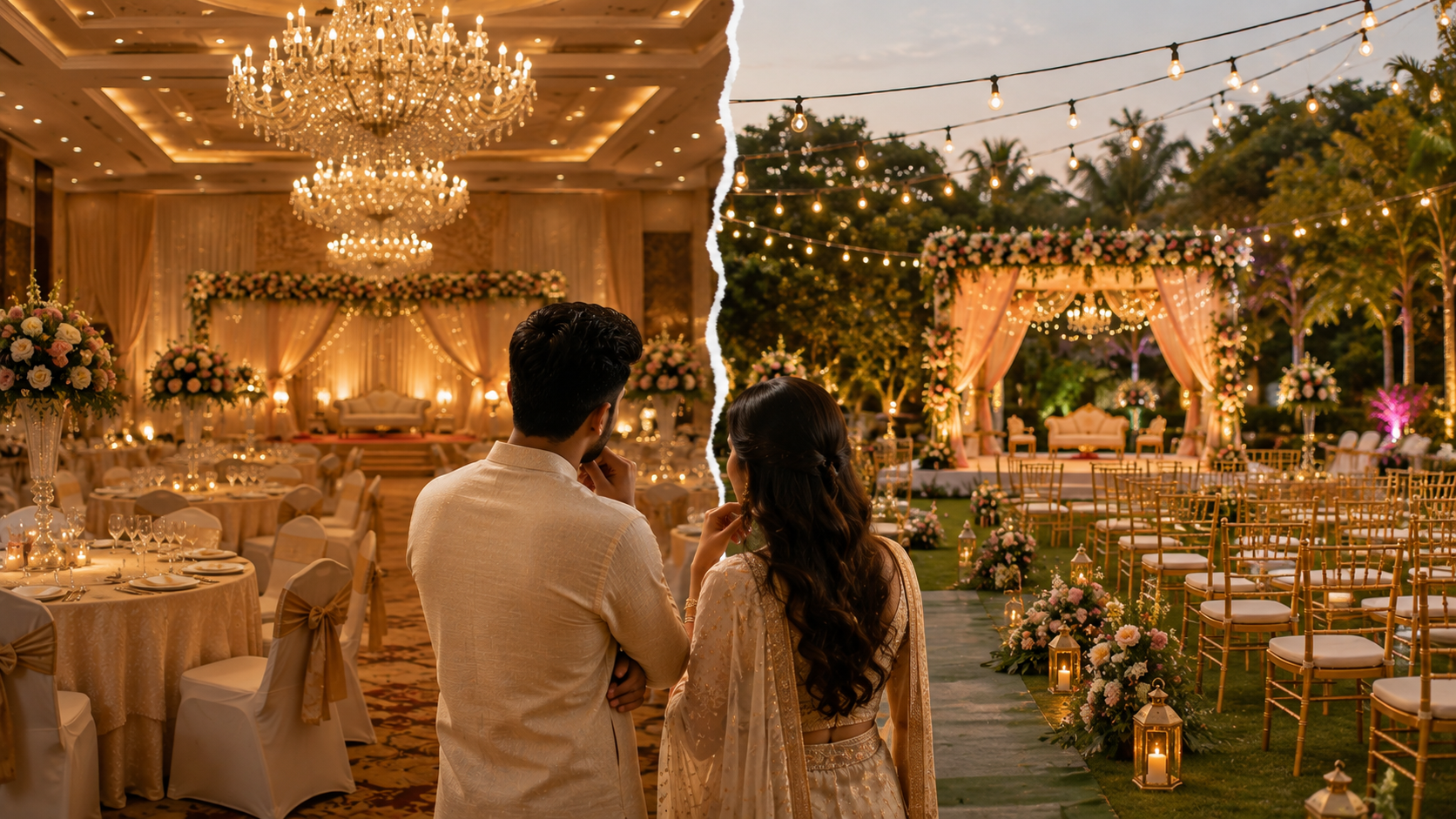
The indoor vs outdoor wedding venue debate rarely has a universal answer because the right setting for a wedding depends almost entirely on specifics: when the wedding is happening, where it's happening, how many guests are attending, and what the couple is actually trying to create. Both settings have genuine advantages that the other can't fully replicate, and both have real limitations that no amount of décor investment can completely overcome. The question isn't which is better in the abstract. It's which is better for this wedding, with this guest list, at this time of year.
Most couples form a preference for one setting early, often based on aesthetic inspiration rather than practical assessment, and then look for venues that confirm that preference rather than evaluating the decision itself. This produces a comfortable process but sometimes a difficult wedding day, particularly when the weather assumption behind an outdoor venue choice doesn't hold or when the indoor space turns out to feel smaller or more constraining than the brief site visit suggested.
What follows is a balanced breakdown of both settings across the factors that matter most, so the decision reflects your specific wedding rather than a general preference.
What Indoor Wedding Venues Offer That Outdoor Settings Can't
The case for an indoor wedding venue rests primarily on reliability, and in the Indian context that reliability is more consequential than it might appear in climates with more predictable weather. An indoor venue delivers a consistent guest experience regardless of whether the wedding falls during a surprise late monsoon shower, an unexpectedly hot afternoon, or a cold December evening that makes an outdoor reception significantly less comfortable than the booking-time forecast suggested.
Sound management is a genuine indoor advantage that becomes particularly relevant for multi-function weddings where several events happen simultaneously or in close sequence. Indoor spaces can be acoustically treated and physically separated in ways that outdoor events fundamentally can't, which matters enormously when the DJ for a sangeet needs to coexist with a quieter ceremonial function happening nearby.
Lighting control is another indoor-exclusive advantage. A well-lit indoor hall with professional event lighting produces a consistent, beautiful visual environment that doesn't compete with unpredictable natural light, doesn't have a hard stop at sunset, and allows the lighting designer to create exactly the atmosphere the evening requires rather than working around what the sky provides. Catering infrastructure is also typically stronger in established indoor venues: professional kitchens, cold storage, and service logistics are more reliably in place than in outdoor setups that depend on hired temporary facilities.
What Outdoor Wedding Venues Offer That Indoor Settings Can't
The case for an outdoor wedding venue is primarily aesthetic and spatial, and within the right seasonal window in India, these advantages are substantial enough to justify the additional planning complexity.
Natural Light and Photography Quality
The photographic difference between an outdoor and indoor wedding, when the outdoor event happens in genuinely good natural light, is significant and consistently noticed in the final images. Soft, directional natural light in the late afternoon and golden hour creates a photographic quality that indoor lighting, however professionally done, approaches but rarely fully replicates. For couples who prioritise their wedding photography and videography, an outdoor setting in the right season and at the right time of day is a genuine creative advantage rather than an incidental preference.
Spatial Flexibility for Large Guest Counts
Large Indian weddings with guest lists of 400, 600, or 800 people have more comfortable options in outdoor settings than most indoor venues can provide. A well-laid-out outdoor lawn creates space for multiple function zones, food stations, a dedicated performance area, and guest movement without the compressed feeling that even large indoor halls can produce at high guest counts. The absence of structural walls means the spatial configuration can adapt to the event rather than the event adapting to the structure.
The Aesthetic of an Open Setting
An outdoor setting creates a sensory experience that no indoor venue fully recreates: the openness of the sky, natural greenery, air movement, and the particular quality of ambient sound that comes from being genuinely outside rather than in an enclosed space. For couples whose wedding vision has this as a central element, no indoor equivalent fully substitutes for it regardless of how well the décor attempts to suggest an outdoor feeling.
Function-Specific Outdoor Advantages
Several wedding functions suit outdoor settings particularly naturally. Haldi functions in daylight hours work beautifully in an open space where natural light is flattering and the active, high-energy nature of the function benefits from room to move. Sangeet evenings have a different quality in an outdoor setting with ambient sky than in an enclosed hall. And welcome functions or pre-wedding gatherings often use outdoor spaces to create a relaxed, social atmosphere that interior rooms find harder to produce.
Is an Outdoor Wedding Cheaper Than an Indoor Wedding?
Often not, despite the assumption that removing walls reduces cost. The outdoor venue's base rental may be lower than an equivalent indoor hall, but the infrastructure that a successful outdoor wedding requires brings costs that close or eliminate the gap: professional-grade sound systems with outdoor coverage, event lighting that can't depend on ambient light, generator backup for all temporary electrical equipment, temporary flooring for areas where guests in formal attire would otherwise be on grass or uneven ground, weather contingency structures, and in some cases temporary toilet facilities beyond what the permanent venue infrastructure provides. The total cost comparison between a well-executed outdoor event and an indoor equivalent at similar scale tends to be closer than it first appears.
The Five Factors That Should Determine Your Decision
Evaluating the indoor vs outdoor decision against these five factors produces a clearer answer than aesthetic preference alone:
Season and climate: is the wedding date in a window where outdoor conditions are reliably comfortable for a multi-hour event, or does the date carry weather risk that an outdoor setting can't adequately mitigate with contingency arrangements?
Guest composition: does the guest list include elderly relatives, very young children, or guests with mobility considerations who will find outdoor surfaces and conditions more challenging than a managed indoor environment?
Aesthetic vision: is the outdoor setting central to the wedding's visual identity and the couple's experience of the day, or is it a preference that an indoor setting could adequately satisfy?
Budget and infrastructure: has the full outdoor infrastructure cost been calculated alongside the base venue rental, and does the total comparison still favour outdoor when these costs are included?
Risk tolerance: what is the contingency plan if weather requires moving indoors, and is that contingency plan good enough that the couple would be genuinely comfortable with it rather than merely resigned to it?
Why Hybrid Venues Are Worth Considering
The indoor vs outdoor binary obscures a third option that resolves many of the practical tensions between the two: hybrid venues that combine meaningful outdoor space with adjacent or connected indoor areas. A garden venue with a covered terrace, a lawn property with an attached hall, or a purpose-designed venue with a semi-outdoor celebration area allows different functions to happen in the setting that suits them while maintaining a fallback for weather-sensitive elements.
Hybrid venues are particularly well-suited to multi-day Indian weddings where different functions have different setting requirements: a haldi in the open garden, a sangeet in the covered outdoor area, and a main reception indoors where sound management and lighting control matter most. This format gives the outdoor aesthetic where it produces the most benefit while reducing the weather dependency that makes fully outdoor events risky outside a narrow seasonal window. Venue By Choice helps couples compare all three setting types, indoor, outdoor, and hybrid, across a comprehensive range of properties, making it easier to evaluate the real options at each budget and location rather than choosing between abstract preferences. Their full venue listing is available at venuebychoice.com.
Which Is Better for Photography: Indoor or Outdoor Wedding?
The photography comparison depends significantly on the specific conditions of each:
Outdoor settings in genuine natural light, particularly late afternoon and golden hour, produce a photographic quality that most indoor venues can't match, with soft, directional, flattering light that costs nothing and looks effortless in images
Indoor venues with professional event lighting produce consistent, reliable photographic results that don't depend on the time of day, weather, or the sun's position, and that allow the photographer to control the visual environment rather than adapt to it
Outdoor events in harsh midday sun, overcast flat light, or after dark without adequate outdoor lighting often photograph worse than well-lit indoor events, making the outdoor photography advantage conditional rather than universal
Indoor venues can produce excellent photographs when the lighting design is thoughtful, but they require more from the photographer and the lighting investment to achieve the same warmth that outdoor natural light provides on a good day
The hybrid setting often produces the best photography outcomes: outdoor for couple portraits and natural light moments during the day, indoor for the primary reception and evening events where controlled lighting outperforms ambient darkness
Conclusion
The indoor vs outdoor wedding venue decision is best made by evaluating five specific factors, season, guest composition, aesthetic priorities, budget including infrastructure, and weather risk tolerance, rather than defaulting to a general preference formed before those factors have been properly considered. Both settings have genuine advantages the other can't fully replicate, and both have real limitations that the right decision acknowledges rather than discovers on the wedding day.
For most Indian couples marrying outside the November to February window in most regions, an indoor venue or hybrid venue provides a more reliable foundation for a celebration that delivers what the planning invested in it. For those marrying within that window with the budget and appetite for outdoor infrastructure, the aesthetic and spatial advantages of a genuinely outdoor setting are worth the additional complexity required to realise them well.